Showing posts with label feedback. Show all posts

Wednesday, November 2, 2016

Max Learning: Give a Man a Mission


"It is my mission!" This was the emphatic response to my redirection from two-year-old Max as he dismantled his grandmother’s French casement window opener.  Apparently, his obsession with the cartoon Little Einstein's was teaching him the concept of a mission. As I pulled him away, kicking and screaming, I would have never guessed that this destructive act would lead me down the path to such a successful strategy for working with him.

For those of you who read my blog, you know that Max is a high energy child. (Click here to learn about Max)  Despite his mother and I having 45 combined years in education working with kids, we still struggle with his behavior. Imagine the discomfort when we were invited to have him be the ring bearer at an outdoor wedding in Vermont. My first thought was, "That is not going to happen." I envisioned a cartoon-like scene in which Max was the Tasmanian devil spinning around eating the pillow with the rings attached and bolting off into the woods. (Click here to see my visualization) My brother-in-law and future sister-in-law pleaded that we involve him. They were willing to take the risk. After many conversations, Courtney and I decided that we would embrace the discomfort and take him as the ring bearer.

With the decision made, Courtney and I began strategizing about how we could make this happen.  During one of our conversations, we remembered how motivated he was when, “on a mission.”  For years as a classroom teacher, putting kids to work was a go-to strategy for active students who would disrupt the class relentlessly if not engaged.  It is one of those seemingly universal ironies for educators that best practice often gets forgotten when working with our biological children! Here is how we used the mission concept to set Max up for success.


Mission Lessons:
1)      Clearly define the mission objective - We told Max that he had an important mission to accomplish at his Uncle Matt’s and Aunt Rachael’s wedding.  We acquired the pillow that he was to carry and tied fake rings to it.  We showed him pictures of his Uncle Matt and told him that he would walk slowly toward him, carrying the pillow.  Once he got to his uncle, he would give Matt the pillow and get a hug.  Max would then walk to Mommy and sit on the front row.   
2)      Provide a model of excellence - To help Max visualize what his mission would look like, we searched You Tube for a video that showed a good model.  It was an intensive search since many of the videos show best how not to do it! 
3)      Break the mission down into parts - We began clearly chunking the process into parts.  We included pillow positioning and the speed of walking as his mastery of the basic skills were established. 
4)      Provide immediate specific feedback - Rather than just celebrating with a “Good job!”, we worked to be very specific as he was practicing.  The feedback sounded like, “Good job bringing the pillow to Mommy.  Next time carry the pillow in both hands.”
5)      Provide positive reinforcement - Max loves Pez candy! We used his sweet tooth to positively reinforce his behavior.  Broken in half, these little candies stretch a long way.  Some may argue that this is a bribe.  This is not true since a bribe is designed to induce someone to do something illegal or dishonest.  The reality is that reinforcers offer a powerful tool for shaping behavior.  Extrinsic motivators are often necessary to find success, with the ultimate goal of being driven from within.  
6)      Provide multiple opportunities to practice over time - Because we had the gift of time, we were able to practice this over and over again. Once we were at the rehearsal in Vermont, the distraction of people and the open woods were a small thing to overcome because he had automaticity. 
7)      Play off of their passion - Max is not a fan of dressing up.  His ring bearer outfit included multiple layers, a vest, a tie and a cap.  Max rarely wears a hat for more than a minute.  This is where playing on his passion for a mission made all the difference.  We sold him that these were his “special mission clothes.” With this approach we had to fight him to take them off, instead of putting them on.
8)      Trust and celebrate - In the end, all that was left was to trust that he would do the right thing.  Despite all the successful practice, I will tell you my heart was thumping like an excited shrew when I set him down and sent him on his way.  We were rewarded with a perfectly accomplished mission.  My Tasmanian devil had been transformed into masterful little solider.  We were so proud!  The pride and love Max felt from his family was the intrinsic motivator that I wanted him most to experience.  I was not disappointed.

As educators, we can get lost in the variability of our learners.  Students with high energy can be disruptive to the learning of others.  Too often we end up in the cycle of redirect, threaten and consequence only to find ourselves frustrated when the behavior change doesn't last.  If you find yourself struggling with one of these busy students, don’t forget to, “Give a man a mission!”


Tuesday, March 1, 2016

A Few Choice Words

     I can’t begin to count the number of times I have said to others, “It is not so much what you say, but how you say it!”  We know this to be true.  From personal experience and research we know our nonverbals and voice tone play the largest part in how others “hear” us. Despite this, word choice is critical.  Recently, I was reading a blog post from one of my favorite Twitter influencers @mssackstein.  Starr has great insight on shifting the focus from grades to learning.  I couldn’t agree more with the quote to the right.  From the questions that we ask, to the statements that we make, we often predispose others in ways that are unintended or even negative.  Let’s look at a few examples and see if we can shift our word choice to set others up for success.

From “wait time” to “think time” – Too often our classroom questioning seems to be more reflective of a game show that values quick response rather than a learning environment that celebrates depth of thinking.  In an effort to address this at my campus, we have been working purposefully to allow students time to process.  Research tends to support a range from 3 to 15 seconds depending on a variety of factors including question complexity and other learner-centered variables.  By discussing this period of processing as “think time” we are giving it a true descriptor.  We want our students to contribute thoughtful answers rather than quick answers that may be accurate but have no depth. 

From “respond in complete sentences” to “respond in complete thoughts” – How do we move others to understand that writing IS A SKILL and NOT a class?  One powerful way to support this critical life skill is to expect our students to respond in complete sentences.  What better way to develop language and writing skills than practice?  When all content areas demand and support students in this, true progress can be made.  When sharing this expectation with students, I prefer the expectation stated as, “Respond in a complete thought.” This captures the essence of what we want our students to be doing… thinking!  Often students view the expectation of responding in “complete sentences” as a waste of time and little more than a handwriting exercise.   

From “use these vocabulary words in your answer” to “speak like a biologist” – One of our great challenges in education is to support the development of academic vocabulary in our students.  My favorite analogy is the description of building a strong foundation of academic language with the use of brick and mortar words.  Brick words are those that are specific to a discipline. Examples of this jargon for biology would be mitochondria, carnivore, or ecosystem.  The mortar words are those that link these words.  Our classrooms are filled with Word Walls that have the potential to support academic language. All too often these Word Walls are little more than decoration.  Master teachers set the expectation that students respond using the words that are posted.  By stating the expectation to include a profession or career choice we help our kids see the value of this type of language.  Who do you ask your students to speak like… an engineer, a writer, a musician or a historian? 

From “let’s get started so we can get through this” to “I promise to value your time” – For most of us, time is one of our most precious resources.  Despite this, we do need people’s time to hear their voice and involve them in problem solving processes.  By focusing the value you put on their time, you will bring the group into focus without demeaning or undermining the work that you need to accomplish.

From “Wow, you made a 100, you must be so smart!” to “Wow, you learned this completely, you must have worked so hard!” – The first statement communicates to the child, the GRADE is the most important thing. You achieved it because you have a natural intelligence for the topic.  This is a classic mistake that we make when trying to positively reinforce kids.  This type of praise reinforces the fixed mindset and celebrates the wrong thing.  The second statement communicates that the LEARNING is the most important thing and hard work is more important than IQ.  This reinforces a growth mindset.  A critical take away here is that we acknowledge achievement but celebrate work ethic.

From “I love the way you extended your questioning” to “The extensions to questions that you used provided an opportunity for students to think at high levels” – Growth happens best when we receive feedback.  The word choice in the feedback that we give our colleagues needs to be specific and focused on the goal… student learning.  When we give feedback that starts with “I love” or “I like it when” it puts the focus on pleasing us.  While most of our staff enjoys pleasing us with their work, the celebration should lie elsewhere.  Let’s focus on what we saw that was best practice or effective.   

From “I have to” to “I get to” – This shift is not only important in how we communicate to others, it impacts our own thinking about our work.  So often we can get swept up in what could be described as the culture of complaint.  Our interactions with others can start with a litany of frustrating things we are encountering and HAVE to deal with.  How do we shift this to a culture of opportunity?  If we can shift our lens to see challenges as opportunities to sharpen our skills or form a new relationship, our attitude improves.  Next time you have a meeting with a challenging parent, can you shift your self-talk to see it as an opportunity to make a connection and strengthen your partnership for the student’s benefit?

      Some might think that attention to these seemingly slight shifts in word choice are not worth the effort.  I wholeheartedly disagree.  As leaders in the classroom and out, communication is central to our work.  Let’s become masters at the craft of wordsmithing.  What are some of your most impactful shifts in word choice?  

Tuesday, December 8, 2015

A Purposeful Walk

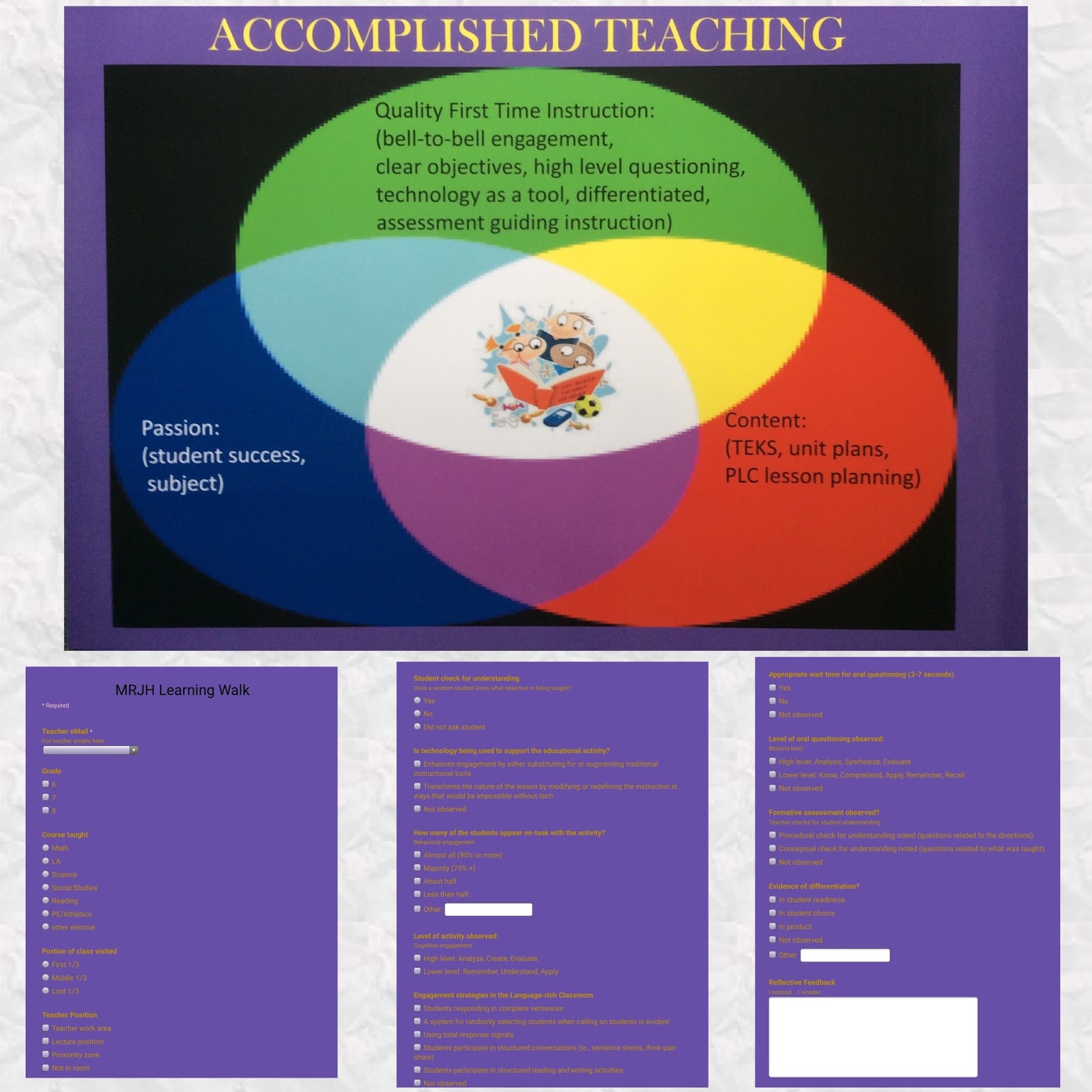
At Morton Ranch Jr. High we are working purposefully to create accomplished masters in the art of teaching.

It is nearly impossible to become masterful at anything worthwhile  without feedback.  This is especially true for complex tasks that have a variety of dynamic variables.  Accomplished teaching is exactly this type of task.  To teach so that all students learn is daunting.  How do we provide feedback to promote reflective practice that maximizes the potential for teachers to become masters of their craft? I would argue that the feedback would have these characteristics:

1)      focused on a target skill or concept (specific in nature)
2)      occurs frequently
3)      is timely
4)      supports reflection and dialogue about instruction

In my experience as a teacher and an administrator, I have found that the instruments used for appraisal are woefully inadequate for this task.  They typically involve longer, less frequent visits that are inspectional in nature.  It is a struggle to get people to be receptive to feedback if they feel they are being judged.  Judgment of effectiveness is at the heart of these tools.  I am not trying to minimize the importance of these tools or the appraisal process, but they do not meet our needs for growing master teachers.

In the spring of 2014, my administrative team, instructional coaches and I began working on an instrument to conduct instructional rounds.  The instrument was designed to reflect the feedback characteristics described above.  The process we were working on has been called a number of different things:  instructional rounds, snapshot visits, mega monitoring, and power walks, just to name a few.  We landed on the term “learning walks” and began the process of collaborating about what should be included.

I believe the journey of creating, communicating, calibrating and executing this reflective tool has brought about an instructional focus that is a challenge for most campuses.  As I mentioned in my previous posts, we have an instructional model that we refer to as our Accomplished Teaching Model.  In an effort to provide feedback that would support our instructional expectations, we used the descriptors from the quality first time instruction area of the model as our primary focus.  Our instrument is in its third version.  Each evolutionary step has been a collaborative effort designed to give deeper alignment to the model. 

Once the instrument was created, it was time to communicate the purpose and process to staff.  As a principal, one of the key decisions that dictates success for any initiative is the manner that it is rolled out.  Because I wanted to have a more intimate, and interactive setting, I made the decision to devote an entire day to meeting with teams each period during their conference time.  I created a Learning Walk Orientation to discuss why we were moving to the use of learning walks.  I also made a point to clearly describe what they were, and were not.  I wanted to assure the staff that this was not an additional appraisal process. 

After I met with the staff, it was time to work on inter-observer reliability.  We shared with staff that we would be visiting in small groups in an effort to get on the same page with the use of the instrument. During this period, we did not provide feedback to the teachers.  We conducted the learning walk and then debriefed on what we saw afterward.  This process of walking together and having focused conversations about what we saw was powerful.  The instructional conversations were engaging and helped us to develop a common vision about what we were looking for based upon our instrument. I created the instrument as a Google form.  The Google platform is ideal because the information captured moves into a spreadsheet that is easy to sort.  The auto emailer feature was also perfect for providing immediate feedback to staff. 

With the lessons learned from the prior school year, we broadened the involvement in learning walks in 2014-2015 to include our Instructional Coaches and teachers. Our core content Instructional Coaches led groups of their teachers into classrooms.  After completing the learning walks, the coach would facilitate a collaborative conversation with the teachers involved in the walk.  The learning walk instrument was used to give focus to the conversation.  Ultimately, the coach would enter the feedback for the team so that the visited teacher could reflect upon it.  This is job-embedded professional learning at its finest. 

Beyond providing staff with specific feedback, the collected data helps to paint a picture of the instructional landscape.  With hundreds of points of data, gathered by a variety of observers, you can feel confident about what is happening in classrooms.  In February of 2015, I met with staff in small groups to share the group data.  Rather than show a series of graphs or tables, I shared the data as a narrative about a typical class at MRJH.  The staff picked out celebrations and areas to grow.


In addition to sharing what was happening in our school, I wanted to gather teacher voice about how we could make it better.  I facilitated a Chalk Talk Protocol to gather feedback at the end of each meeting.

Focus questions included:
  How would you prefer to receive feedback after learning walks?
  The learning walk process could be improved for me by…

This feedback was used to improve our third version of the MRJH Learning Walk instrument we are using for the 2015-2016 school year. 

I am extremely proud of the work my staff has put into this process.  We ended last school year with well over 1,000 learning walks conducted by administrators, instructional coaches and teachers.  I am proud of my staff for leaning into the discomfort of having many people in their rooms, holding up a mirror to their instructional practices.  I think it is a tragic irony that educators, who have great pride in giving quality feedback, would struggle so greatly to receive it.  It is imperative that we drop our defenses, and open ourselves to the collegial feedback that is necessary for us to become accomplished masters of our craft.  Our kids are depending on us. As the lead learner at my campus, I am savoring the journey that this purposeful walk is taking us on.