Wednesday, March 9, 2016

There is NO CRYING in Kahoot!

 "Are you CRYING? There is NO CRYING IN KAHOOT!!" This thought echoed in my mind as I watched a student break down sobbing in class.  How do you make an 8th grade boy cry in a room full of his peers?  From my recent experience, the answer to this question could be, “Use technology.”  In February, I was conducting a learning walk in an 8th grade classroom.   It was near the end of class and the teacher was closing the lesson with the platform known as Kahoot! For those of you who are unfamiliar with Kahoot!, the quote below is how its developers describe it.  


So how does a gaming experience that promises to “make it fun to learn” turn into an activity that tears are shed over?  As I reflected over what I saw, I believe these factors sent this well-intentioned lesson element into a downward spiral.

The class was an advanced-standing class (Pre AP) with students that are grade-motivated. Earlier, it was communicated to the class that this activity would be for a grade. Unfortunately, many of our high achieving students define themselves by the grades they make rather than the learning they engage in.  They have been celebrated all their lives for being ‘smart’ and things have come easily for them historically.  When these fixed mindset students struggle in an academic setting, it sets their world on edge.  Some devalue and disengage from the activity itself.  You can hear them processing this when they say things like, “This is so stupid.”  In this case, the young man took his failure personally and it impacted his self-esteem.  If one could hear the self-talk from students in this state it would sound like, “I am so stupid.”

The Kahoot that was used was created by a different teacher.  This became an issue during the game because one of the questions referred to a specific acronym. That acronym was not taught in the way the question was phrased.   It was a classic example of a misalignment between instruction and assessment.  

Students only had 15 seconds to answer before the game moved on to the next question.  For certain questioning, this amount of think time is more than adequate.  In this case it was not.  One could hear the audible expressions of frustration as the game moved forward prior to students inputting their answers.  

So what do we do to avoid situations like this?  

Let’s be cautious about assigning grades to certain assignments.  If a game show atmosphere is something a teacher wants to capitalize upon to create engagement, a grade might not be appropriate.  We need to remember that the purpose of a grade is to reflect and communicate mastery.  If factors are involved that impact a true representation of mastery, let’s not assign a grade.  Develop practices that deemphasize the grade and focus on giving your students feedback.  Celebrate mistakes, hard work, and the process.  These things support a growth mindset and set our kids up to persevere through the struggles they will inevitably need to conquer on their life’s journey.  Quit telling your students that they are “smart.”  Feel free to acknowledge achievement but remember to celebrate the effort.  Make this statement part of your vernacular, “Wow, you demonstrated your complete understanding of this by making a 100.  You must have really worked hard!”

Let’s remember that technology is meant to be a tool for instruction.  Often times we become enamored with hardware, software, or web tools and bring them into a lesson without a clear instructional purpose.  This is akin to purchasing a drill and hunting around your house for a hole to make.

Extend the processing time you allow students to have when assessing what they know.  We need to move away from celebrating a quick response toward recognition of deeper answers that show complex thinking.  Let’s be purposeful in allowing our kids the think time they need.  A quiz show simulation may engage students in the moment, but we do not want to reinforce the misperception that learning is all about answering quickly.  

I want to end this post by celebrating the teacher in this story.  After the lesson, I scheduled a coaching conversation with her to give her feedback.  My goal was to coach her up on the use of Kahoot! and some of the issues I raised here.  Once we sat together, she had already taken steps to improve her use of this technology as a tool.  She researched how to extend the time students have to answer.  She shared with me the struggles of the emotional 8th grader who was crying.  It is clear that she knows and cares about her kids.  I was very proud of the fact that she was reflective about the lesson and had already taken steps to improve it next time around.  This is just what I want from my staff as we move from congeniality to collegiality.


Tuesday, March 1, 2016

A Few Choice Words

     I can’t begin to count the number of times I have said to others, “It is not so much what you say, but how you say it!”  We know this to be true.  From personal experience and research we know our nonverbals and voice tone play the largest part in how others “hear” us. Despite this, word choice is critical.  Recently, I was reading a blog post from one of my favorite Twitter influencers @mssackstein.  Starr has great insight on shifting the focus from grades to learning.  I couldn’t agree more with the quote to the right.  From the questions that we ask, to the statements that we make, we often predispose others in ways that are unintended or even negative.  Let’s look at a few examples and see if we can shift our word choice to set others up for success.

From “wait time” to “think time” – Too often our classroom questioning seems to be more reflective of a game show that values quick response rather than a learning environment that celebrates depth of thinking.  In an effort to address this at my campus, we have been working purposefully to allow students time to process.  Research tends to support a range from 3 to 15 seconds depending on a variety of factors including question complexity and other learner-centered variables.  By discussing this period of processing as “think time” we are giving it a true descriptor.  We want our students to contribute thoughtful answers rather than quick answers that may be accurate but have no depth. 

From “respond in complete sentences” to “respond in complete thoughts” – How do we move others to understand that writing IS A SKILL and NOT a class?  One powerful way to support this critical life skill is to expect our students to respond in complete sentences.  What better way to develop language and writing skills than practice?  When all content areas demand and support students in this, true progress can be made.  When sharing this expectation with students, I prefer the expectation stated as, “Respond in a complete thought.” This captures the essence of what we want our students to be doing… thinking!  Often students view the expectation of responding in “complete sentences” as a waste of time and little more than a handwriting exercise.   

From “use these vocabulary words in your answer” to “speak like a biologist” – One of our great challenges in education is to support the development of academic vocabulary in our students.  My favorite analogy is the description of building a strong foundation of academic language with the use of brick and mortar words.  Brick words are those that are specific to a discipline. Examples of this jargon for biology would be mitochondria, carnivore, or ecosystem.  The mortar words are those that link these words.  Our classrooms are filled with Word Walls that have the potential to support academic language. All too often these Word Walls are little more than decoration.  Master teachers set the expectation that students respond using the words that are posted.  By stating the expectation to include a profession or career choice we help our kids see the value of this type of language.  Who do you ask your students to speak like… an engineer, a writer, a musician or a historian? 

From “let’s get started so we can get through this” to “I promise to value your time” – For most of us, time is one of our most precious resources.  Despite this, we do need people’s time to hear their voice and involve them in problem solving processes.  By focusing the value you put on their time, you will bring the group into focus without demeaning or undermining the work that you need to accomplish.

From “Wow, you made a 100, you must be so smart!” to “Wow, you learned this completely, you must have worked so hard!” – The first statement communicates to the child, the GRADE is the most important thing. You achieved it because you have a natural intelligence for the topic.  This is a classic mistake that we make when trying to positively reinforce kids.  This type of praise reinforces the fixed mindset and celebrates the wrong thing.  The second statement communicates that the LEARNING is the most important thing and hard work is more important than IQ.  This reinforces a growth mindset.  A critical take away here is that we acknowledge achievement but celebrate work ethic.

From “I love the way you extended your questioning” to “The extensions to questions that you used provided an opportunity for students to think at high levels” – Growth happens best when we receive feedback.  The word choice in the feedback that we give our colleagues needs to be specific and focused on the goal… student learning.  When we give feedback that starts with “I love” or “I like it when” it puts the focus on pleasing us.  While most of our staff enjoys pleasing us with their work, the celebration should lie elsewhere.  Let’s focus on what we saw that was best practice or effective.   

From “I have to” to “I get to” – This shift is not only important in how we communicate to others, it impacts our own thinking about our work.  So often we can get swept up in what could be described as the culture of complaint.  Our interactions with others can start with a litany of frustrating things we are encountering and HAVE to deal with.  How do we shift this to a culture of opportunity?  If we can shift our lens to see challenges as opportunities to sharpen our skills or form a new relationship, our attitude improves.  Next time you have a meeting with a challenging parent, can you shift your self-talk to see it as an opportunity to make a connection and strengthen your partnership for the student’s benefit?

      Some might think that attention to these seemingly slight shifts in word choice are not worth the effort.  I wholeheartedly disagree.  As leaders in the classroom and out, communication is central to our work.  Let’s become masters at the craft of wordsmithing.  What are some of your most impactful shifts in word choice?  

Monday, February 15, 2016

Honoring Influencers

     I am a believer in the old adage, “Give credit where credit is due.”  In fact, this was a major issue that I grappled with when I first considered creating a blog.  The last thing I want others to believe is that I am attempting to be credited for their idea.  Professionally, I have been influenced by a variety of people inside and outside the field of education through conferences and various forms of media including books, articles, videos, blogs, etc. I think an apt descriptor for these individuals is the term, "influencer."  I am indebted to influencers for my success as a leader.   How do I honor those that have shaped my thoughts, opinions and ultimately my actions?  This post is an attempt to identify and celebrate a few of the people who have shaped my professional work.  I strongly suspect that as you recognize those on the list and my takeaways from each influencer, you will be nodding your head in acknowledgment of their impact.  

Roland Barth – influenced the way I look at professional relationships in the workplace.  It is critical that we move beyond mere congeniality toward collegiality to foster the growth of our organizations.

Brene Brown – influenced my understanding of the connection between shame, vulnerability, and their impact on relationships.  We must “lean into the discomfort” if we are to grow.

Camerer, Loewenstein and Weber – influenced me to be mindful of, “The Curse of Knowledge.”  This cognitive bias makes it extremely difficult for the experienced individual to think about problems from the perspective of the novice.  Many times, those with the deepest knowledge about a subject struggle the most communicating their understanding to others, especially kids.  Educators MUST beware this curse!

Jimmy Casas – influenced my view of what it means to be a “connected educator.” Without his influence, you would not be reading this post because it would never have been written.

Jim Collins – influenced the steps I use to transform my school.  He helped me to realize that there is inherent complacency when you are in a “good” organization.  The sequence of facing the brutal facts, focusing on getting the right people into the right role, and ultimately providing a simplified focus for your organization based upon passion, drives my work.  Leadership 101.

David Cottrell – influenced my thoughts on increasing the rigor of hiring staff and being purposeful in celebrating the “Superstars.”

Stephen Covey – influenced my thoughts on what to focus on as a leader and the best means to do it… through collaboration.  Love the proactive plea of, “Begin with the end in mind.”

Rick DuFour – influenced the way I see teams working as Professional Learning Communities. His four PLC questions move teams from simple delegation of tasks to collaborating about student learning.

Carol Dweck – influenced my understanding of how one’s mindset put us on a path to grow, or fixes us in our current level of proficiency.  She fundamentally changed the way I praise.  “You are so smart” is no longer in my vernacular. 

Eric Jensen – influenced my understanding of the plasticity of the brain as well as how we best support students that come from poverty.  Our economically disadvantaged students need language development much like an English language learners. 

Patrick Lencioni – influenced my understanding of how trust is the foundation of high functioning teams.  Enemies to our teams are a lack of vulnerability, artificial harmony, an unclear purpose, and ego. 

Robert Marzano – influenced my knowledge of research-based effective strategies. More recently, his work on the development of proficiency scales has been central to our work with standards-based learning.

McTighe and Wiggins – influenced the way I see lesson planning to focus on student understanding.  The concepts of backward design, essential questions and enduring understandings have become so common to PLC planning, many have forgotten where the terms were coined.

Alan November – influenced the way I see technology as a tool.  He led me down the path to Twitter which has fundamentally changed the way I learn professionally.

Malichi Pancoast – influenced how my assistant and I work in partnership to support the school.  Shifts in how my time is managed have put me in more classrooms than ever before.  Breakthrough coaching in a MUST for any new principal/secretary partnership and will even benefit veterans.

Ruby Payne – influenced my understanding of the effects of poverty on students.  An awareness of how the hidden rules of economic class translate into our need teach the ‘unwritten’ rules for success in school came to light through her work.  The concept of language registers and the need to work with students to develop an ability to see the need to move between registers was a big take away. 

Rita Pearson – influenced the way I deescalate argumentative parents.  She reminded me to always start with what the student can do, even it is at a very low level because, “Every child needs a champion!”

Daniel Pink – influenced my understanding of what motivates people intrinsically.  External reinforcers are great motivators for low level tasks.  For high level tasks, autonomy, mastery and a sense of purpose drive us from within. 

Sir Ken Robinson – influenced my views on how we need to adapt our current system to move away from the factory model of education and embrace personalized learning.  Real talk about what we currently DO to kids and what we should be doing FOR students.

Simon Sinek – influenced the way I start conversations to innovate or initiate change.  Focusing on the “why” instead of the “how” engages people.

Randy Sprick – influenced the way I viewed structuring classrooms and lessons.  CHAMPS and elements of this approach are common place throughout classrooms on my campus because of his work.

Carol Ann Tomlinson- influenced how I see differentiation as a means to provide opportunities for success with a range of learner competencies. Her teachings hold the keys to much of the personalized learning that we all seem to struggle to bring into classrooms.

Todd Whitaker – influenced the way I view “greatness” in a variety of educational roles.  Additionally, he has informed my skill set that moves responsibility from one staff member to the appropriate staff member.  Shifting that monkey!

Rick Wormeli – influenced the way I view assessment and grading.  He has created the moral imperative for me to work with a standards-based approach to instruction.

Harry Wong – influenced my understanding of the importance of clear expectations and routines to manage my classroom when I began teaching.  More importantly that is was OK to tell your class, “I Love You.”

     As I am drawing this list to a close, I am smiling at how incomplete it truly is.  Imagine throwing a fistful of gravel into a still pond and trying to find which individual pebble created a unique wave that impacts the shore among hundreds of waves.  That task would be easier than identifying our influencers.  With that in mind, let us as connected educators, not stress too much with “giving credit where credit is due.”  I strongly suspect if you were to interview any of the influencers listed, they would be quick to name those who influenced them to develop the ideas they have shared.  Instead, let us focus on becoming more connected as we act as superconductors of ideas and information.  What are you doing to multiply your influence and number of voices you are influenced by?  

Monday, February 1, 2016

A Mosaic of the Mind: Influencers, Information, and Ideation

     As a servant leader, there is no higher praise than when I discover that I have influenced another person in a positive way.  In my professional career, I have worked with many people who have set me on the path to grow and empowered me to develop the skill set necessary to lead.  Beyond those that I have worked directly with, I have been influenced by a variety of people inside and outside the field of education through conferences and various forms of media including books, articles, videos, blogs, etc. I think an apt descriptor for these individuals is the term, “influencer.”

     I am a lover of learning and sometimes feel that I am awash in a sea of information and ideas. The growth of my PLN to include Twitter has amplified the number of influencers I am exposed to and put me on a seemingly exponential professional growth curve.  I am more connected that I have ever been.  Consequently, I am exposed to quotes, opinions and innovations on a daily basis.  I am highly engaged when processing information and ideas.  I find myself validated when they resonate with my belief system. More importantly, I am challenged when new information or ideas conflict with what I hold to be true.  I am stretched to go beyond my perception and develop a deeper understanding of reality. This is the type of learning that I value the most.  Like a mosaicist that collects pieces that have individual beauty to his eye, I collect these ideas.  

     Our district staff development department recently supported our professional growth by allowing us to participate in the Gallup StrengthFinder survey.  Upon completion of the survey, each participant was provided with 5 signature themes that described their strengths.  Ideation was one of the themes that was recognized as a strength for me.  The folks with Gallup provide a basic description for each theme to help us gain a better understanding of what they represent.  “People who are especially talented in the ideation theme are fascinated by ideas.  They are able to find connections between seemingly disparate phenomena.” What jumps out at me is the word, “connections.” I see this ability to connect information and ideas at the heart of innovation and ultimately organizational improvement.   Innovation is more about connecting information and ideas than coming up with something that is truly novel.  Mark Twain may have said it best with this quote:
"There is no such thing as a new idea. It is impossible. We simply take a lot of old ideas and put them into a sort of mental kaleidoscope. We give them a turn and they make new and curious combinations. We keep on turning and making new combinations indefinitely; but they are the same old pieces of colored glass that have been in use through all the ages."         Mark Twain
     Twain uses the analogy of a kaleidoscope to capture his thoughts on new ideas.  I prefer an analogy based upon a mosaic.  An artist who works to create a mosaic has a clear vision of what the big picture will be.  He then culls through tiles, glass, or other pieces that will ultimately be used to create the bigger image.  He may have collected elements of the mosaic over a long period of time for future use.  As a master of his craft, he must have an eye for the individual beauty of the parts, but also the skill to connect them to create the overall image. 

     I am the lead learner of a school family with over 1,300 human beings under my care.  With this comes huge responsibilities and expectations.  To meet these expectations, I commit to become increasing connected to multiple influencers through an expanding PLN.  I will filter ideas and information through my values and bring them to action when I think it is best to do so for the members of my school family.  I also commit to pay it forward by serving as a conduit for the flow of ideas and information.  This is my bigger purpose, to serve others by sharing.  I strive to find true joy in the service of others, not in personal recognition.  Perhaps in this way, I can provide just the right piece for the mosaic that a colleague is creating for their organization.  How are you building your personal capacity to be influenced by innovative ideas and support others?

Friday, January 8, 2016

An Instructional Conversation Worth Having

Many times well-intentioned practices can fall short of their potential.  The yearly professional development goal setting process has been just this sort of practice until this school year at MRJH.  Because of the top-down, directive format used, it became something that we did TO teachers instead of FOR teachers. Traditionally, we used a prescribed approach in which administrators provided the goal with a specific percentage score to be reached on a STAAR exam in their content area.  Teachers of courses that were not STAAR tested set goals based upon the percentage of students passing their classes for the year.  The activities that were identified to support reaching their goals were also supplied to the teachers. These activities reflected the campus focus for the year.  In an effort to simplify the measurement of the goal by a percentage score, we created a process that was perfunctory in nature.  The goal-setting process became a compliance piece with minimal teacher buy-in.  Our goal was to create a reflective process for teachers that was based on their growth needs.
 
We have been working on the development of standards-based learning within our Reader’s and Writer’s Workshop models in language arts.  For the past two years, that department has been creating proficiency scales based upon the TEKS.  These proficiency scales are rubrics that describe a continuum of four competencies ranging from novice to exemplary.  Our teachers confer with students based upon the scales.  This allows for clear articulation of where students are in relation to the standard and provides support and direction to achieve the next level of proficiency.  The use of these scales with students has transformed our language arts instruction.  Teachers have a deep understanding of where students are in their learning.  Students develop self-awareness of their current skill set and have a clear plan for growth.  To watch our master teachers confer with students is a thing of instructional beauty!  As an administrative team, this process appealed to us and we made the decision to model our goal setting process with teachers after it.

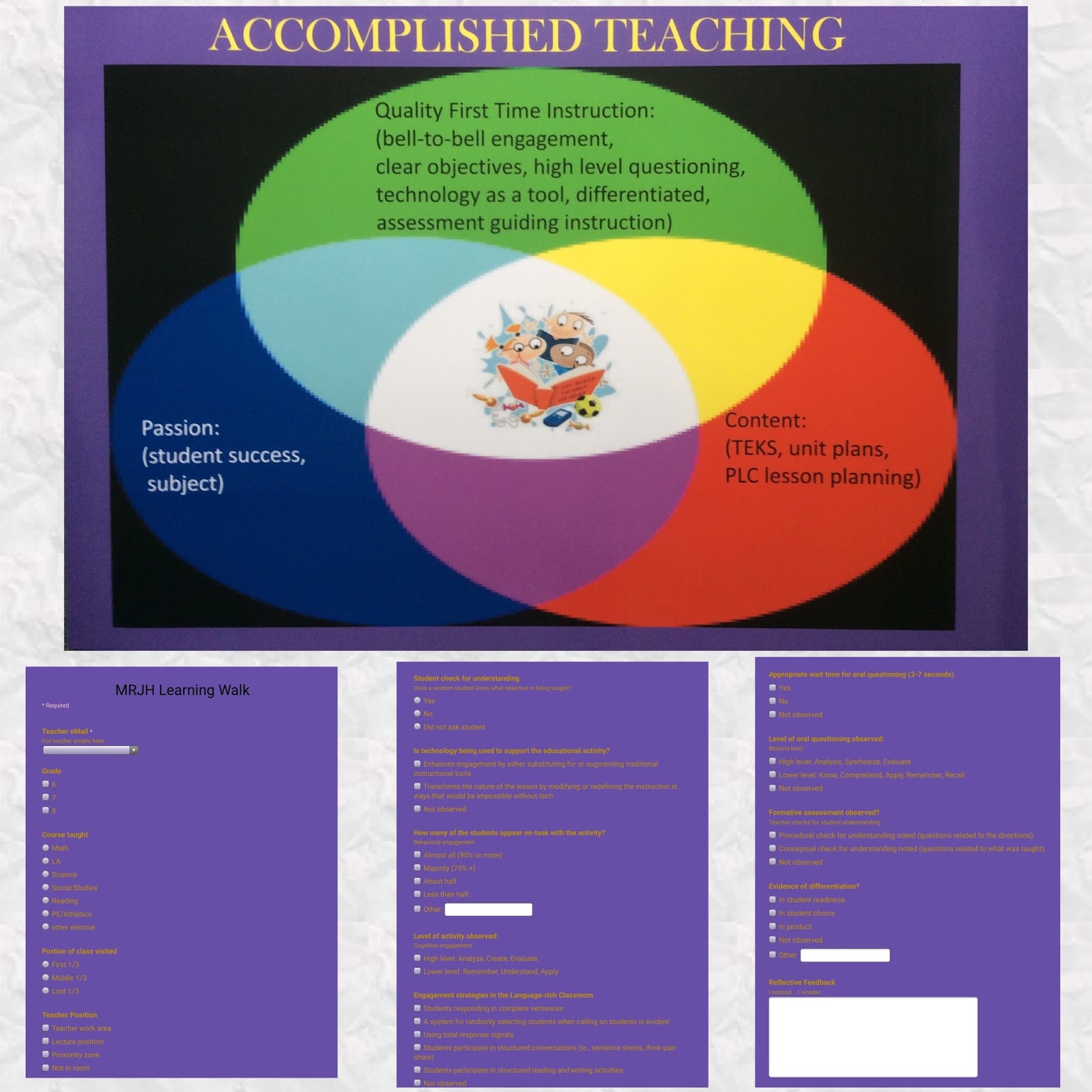
If you have followed my blog, you are aware that we have an instructional model at MRJH we refer to as The Accomplished Teaching Model.  The model has three primary areas of focus.  These include quality first time instruction, content alignment, and a passion for student success and subject area.  For the development of the scale, we began to dissect the quality first time instruction area of our model.  As a Title One eligible campus, we focus on doing things right the first time, instructionally speaking.  The major areas that we concentrate on are clear learning objectives, bell-to-bell engagement, high level questioning, using technology as a tool, differentiation, and the use of assessment to guide instruction.  For the purposes of goal setting, my administrative team created a rubric that specifically described the competencies in each of the six areas at four levels of a continuum.  We classified these levels as novice, emerging, proficient, and exemplary.  We spent many hours involved in instructional conversation as a team.  In my opinion this is PLC work at its finest.  Because of the collaborative process used in creating this document, my administrative team has great clarity about what quality first time instruction looks like.  We entitled this rubric our Accomplished Teaching Proficiency Scale. 


With the scale developed we began discussing how we would use it for teacher goal-setting.  We wanted to mirror the conferring model our language arts department was using with students.  Ultimately each of the administrative staff provided a copy of the scale to the instructional staff they supervised.  We asked the teachers to read the scale and reflect upon where they were on the continuum for each area of quality first time instruction.  Administrators then sat with each staff member to discuss their self-identified competencies.  We worked to ask probing questions.  After all areas were discussed, we asked our staff to identify two areas that they would like to become more masterful at.  These areas became the focus of their professional development goals for the year. Without exception, our teachers shared that this new goal setting process was more meaningful than what we had done in the past.  My administrative team enjoyed playing the role of coach as we explored each area of the model with our teachers.

Our new goal setting process supports deep alignment with our instructional model and sets the expectation for teachers to grow through reflective practice.  I believe that this process supports teachers in becoming masters at their craft.  These are instructional conversations worth having.


Tuesday, December 8, 2015

A Purposeful Walk

At Morton Ranch Jr. High we are working purposefully to create accomplished masters in the art of teaching.

It is nearly impossible to become masterful at anything worthwhile  without feedback.  This is especially true for complex tasks that have a variety of dynamic variables.  Accomplished teaching is exactly this type of task.  To teach so that all students learn is daunting.  How do we provide feedback to promote reflective practice that maximizes the potential for teachers to become masters of their craft? I would argue that the feedback would have these characteristics:

1)      focused on a target skill or concept (specific in nature)
2)      occurs frequently
3)      is timely
4)      supports reflection and dialogue about instruction

In my experience as a teacher and an administrator, I have found that the instruments used for appraisal are woefully inadequate for this task.  They typically involve longer, less frequent visits that are inspectional in nature.  It is a struggle to get people to be receptive to feedback if they feel they are being judged.  Judgment of effectiveness is at the heart of these tools.  I am not trying to minimize the importance of these tools or the appraisal process, but they do not meet our needs for growing master teachers.

In the spring of 2014, my administrative team, instructional coaches and I began working on an instrument to conduct instructional rounds.  The instrument was designed to reflect the feedback characteristics described above.  The process we were working on has been called a number of different things:  instructional rounds, snapshot visits, mega monitoring, and power walks, just to name a few.  We landed on the term “learning walks” and began the process of collaborating about what should be included.

I believe the journey of creating, communicating, calibrating and executing this reflective tool has brought about an instructional focus that is a challenge for most campuses.  As I mentioned in my previous posts, we have an instructional model that we refer to as our Accomplished Teaching Model.  In an effort to provide feedback that would support our instructional expectations, we used the descriptors from the quality first time instruction area of the model as our primary focus.  Our instrument is in its third version.  Each evolutionary step has been a collaborative effort designed to give deeper alignment to the model. 

Once the instrument was created, it was time to communicate the purpose and process to staff.  As a principal, one of the key decisions that dictates success for any initiative is the manner that it is rolled out.  Because I wanted to have a more intimate, and interactive setting, I made the decision to devote an entire day to meeting with teams each period during their conference time.  I created a Learning Walk Orientation to discuss why we were moving to the use of learning walks.  I also made a point to clearly describe what they were, and were not.  I wanted to assure the staff that this was not an additional appraisal process. 

After I met with the staff, it was time to work on inter-observer reliability.  We shared with staff that we would be visiting in small groups in an effort to get on the same page with the use of the instrument. During this period, we did not provide feedback to the teachers.  We conducted the learning walk and then debriefed on what we saw afterward.  This process of walking together and having focused conversations about what we saw was powerful.  The instructional conversations were engaging and helped us to develop a common vision about what we were looking for based upon our instrument. I created the instrument as a Google form.  The Google platform is ideal because the information captured moves into a spreadsheet that is easy to sort.  The auto emailer feature was also perfect for providing immediate feedback to staff. 

With the lessons learned from the prior school year, we broadened the involvement in learning walks in 2014-2015 to include our Instructional Coaches and teachers. Our core content Instructional Coaches led groups of their teachers into classrooms.  After completing the learning walks, the coach would facilitate a collaborative conversation with the teachers involved in the walk.  The learning walk instrument was used to give focus to the conversation.  Ultimately, the coach would enter the feedback for the team so that the visited teacher could reflect upon it.  This is job-embedded professional learning at its finest. 

Beyond providing staff with specific feedback, the collected data helps to paint a picture of the instructional landscape.  With hundreds of points of data, gathered by a variety of observers, you can feel confident about what is happening in classrooms.  In February of 2015, I met with staff in small groups to share the group data.  Rather than show a series of graphs or tables, I shared the data as a narrative about a typical class at MRJH.  The staff picked out celebrations and areas to grow.


In addition to sharing what was happening in our school, I wanted to gather teacher voice about how we could make it better.  I facilitated a Chalk Talk Protocol to gather feedback at the end of each meeting.

Focus questions included:
  How would you prefer to receive feedback after learning walks?
  The learning walk process could be improved for me by…

This feedback was used to improve our third version of the MRJH Learning Walk instrument we are using for the 2015-2016 school year. 

I am extremely proud of the work my staff has put into this process.  We ended last school year with well over 1,000 learning walks conducted by administrators, instructional coaches and teachers.  I am proud of my staff for leaning into the discomfort of having many people in their rooms, holding up a mirror to their instructional practices.  I think it is a tragic irony that educators, who have great pride in giving quality feedback, would struggle so greatly to receive it.  It is imperative that we drop our defenses, and open ourselves to the collegial feedback that is necessary for us to become accomplished masters of our craft.  Our kids are depending on us. As the lead learner at my campus, I am savoring the journey that this purposeful walk is taking us on.

Sunday, November 8, 2015

From Delegation to Collaboration

At Morton Ranch Jr. High we strive to provide quality first time instruction with a passion for the content we are teaching and our student’s success.  This high purpose can be for naught if it is not directed at the right target!  In Texas, we have been provided a clear set of learning objectives.  The Texas Essential Knowledge and Skills (TEKS) give guidance to the ‘what’ our students are to learn. 
                The 2013-2014 school year was the third for our Accomplished Teaching Model.  During staff development week we discussed our new on-line lesson planning platform, Eduphoria Forethought.  We became familiar with the new district unit plans which are designed to provide the scope and sequence for our content areas.  We also revisited the Professional Learning Community (PLC) concept as the team structure we use for planning instruction.


                The TEKS are central to our work in the State of Texas.  Let me give you an example of an 8th grade science TEK:

“The student is expected to differentiate between speed, velocity, and acceleration.” 

                I want to focus on this specific target to make a point that many teachers miss.  Too often, we focus on the bolded part of this objective, “The student is expected to differentiate between speed, velocity, and acceleration.” This is the content of what we are to teach and students are to learn.  Considering ourselves informed, we go in search of activities that allow us to memorize the speed formula, calculate velocity and recognize acceleration.  While these are all worthy endeavors, they are not completely on target.  The master teacher sees the learning target in this way, “The student is expected to DIFFERENTIATE between speed, velocity, and acceleration. “  The verb is critical to the target!  It speaks to the level of thinking and understanding necessary for success.  For a student to differentiate these concepts, we are pushing them to higher levels of cognition.  The student must analyze and develop an understanding of the relationship between the three.  When a teacher is masterful at their craft, they are purposeful in designing engaging learning experiences related to the entire learning target, including the verb. As important as it is to learn about motion concepts, one might argue that it is more important to learn how to think!  For my Texas friends, check out the app pictured below as an easy reference to the standards.


                 In my district, our curriculum experts and select teachers, have organized the TEKS into what we call unit plans.  Our unit plans are like a scope and sequence on steroids!  They are created in a modified Understanding by Design (UbD) format.  I am ever impressed by the work put into designing these documents.  My belief is that this resource-rich, high quality curriculum is one of the reasons Katy ISD is a high performing district.  I am a fan of the UbD approach because it recognizes and identifies enduring understandings that students should take away from classroom experiences that can sometimes are confused by the trivial.  The essential questions are thought provoking and a model for how teachers can create a platform for high level thinking.  Our unit plans give order to the content story we tell in our classrooms.
                In my opinion, there is no group on a campus that will dictate the success of students more than grade-level content PLCs.  This is where the rubber meets the road, instructionally speaking.  This is an area that received the most attention for our staff professional development during the 2013-2014 school year.  Frankly, it is still a work in progress.  The professional learning community (PLC) concept hit my radar in 2005 when I was involved in a book study of the title, “Whatever It Takes” (DuFour, Dufour, Eaker and Karhanek).  The PLC concept appealed to me because it shifted the focus from teacher behavior to student learning.  The four critical PLC questions are a simple but powerful guide for functional collaborative teams who are passionate about student success.           

  1. What is it we expect our students to learn?
  2. How will we know when they have learned it?
  3. How will we respond when some students do not learn?
  4. How will we respond when some students already know it?

                When used by a true PLC, these questions lend clarity to our learning targets, assessment, intervention and differentiation.  Unfortunately, many teams have not evolved to become professional learning communities.  Let’s look at a fictional non-example to lend clarity to this dilemma. 

A 7th grade content team that is comprised of 5 teachers has a common planning time at 4th period.  They have committed to meet every Tuesday to plan.  Members have agreed to start 5 minutes after the tardy bell so that everyone can take care of their personal needs.  The full team is typically not fully gathered until 10 minutes after the bell, with one team member that is usually the last to arrive.  The team does not have a clear agenda and begins the conversation for next week’s planning by looking at the activities that they did last year.  There is a limited discussion about what activities would be best and most commit to the activities.  At this point the conversation shifts to delegating tasks.  One team member agrees to make copies.  Another team member agrees to input the lesson plans electronically for the group.  The team is friendly and has little conflict.  On the occasion when the team does not finish planning, there is rarely a plan to meet again during the week until the job gets done.  During instruction, some of the members of the team opt out of teaching the agreed upon activities.  They use alternates that they have a personal preference for.  When common assessments are given, the team’s follow up data conference finds low levels of instructional conversation and personal accountability.  Rather than reflect on instruction, the majority of time is spent discussing “bad test questions,” and a lack of student effort on assessment.  Comparison of teacher data is low-level or nonexistent.  When obvious learning targets have been missed, little attention is given to how the team will address these gaps.  Frequently the answer is to spiral the missed content into future instruction as the primary means of remediation.  No thought is given to ongoing assessment of the learning target that was missed.  The unspoken attitude is, “We are moving on.” 


                So here lies our great challenge.  How do we move dysfunctional teams to instructionally focused PLCs?  How can we move from delegation of tasks to collaboration about instruction?  Here are areas that I think will move your teams down the continuum:

1)      Expect each team to establish norms and hold each other accountable to meeting the shared agreements.  
2)      Have each team reflect on where they are in the journey and work to provide clarity about what a PLC is and is not.  A great resource for this is the workbook, “Learning by Doing” (Dufour, Dufour, Eaker and Many).
3)      Help teachers to understand that being vulnerable and transparent is necessary in the PLC and expected.  Share Brene Brown’s work the the power of vulnerability.  Vulnerability is perhaps the truest form of courage.  Her book “Daring Greatly” is a read that will shift the way one sees the world. 
4)      Model and expect a shift from shift from congeniality to collegiality.  Simply being nice to one another without real talk about what needs to shift get us nowhere.  
5)      Provide administrative or other support to meet with the PLC teams.  Instructional coaches or administrators who have experience in the content area can potentially be huge resources for a PLC.  Their role is to be present during planning time as a support and a liaison to resources.  They should not lead the meeting.  Investing in our teams is a critical function for support staff.

6)      For especially difficult situations, take the team through a book study of   “The Five Dysfunctions of a Team” (Lencioni)

                The primary director of content is the state.  The primary director of the sequence and supporting resources for the content is the district.  We leave the instructional design decisions up to our teachers.  Teams and specifically PLCs provide the synergy to ensure that we get more than the sum of the individuals sitting around the table to make those decisions.  It is with great faith and hope that I believe our teachers have the will and skill to lead our students to success. My role, as the principal, is to provide the appropriate pressure and support to move our campus forward.